

Fixes
AI-generated fix suggestions from failing traces — reviewed, then dispatched to a coding agent.
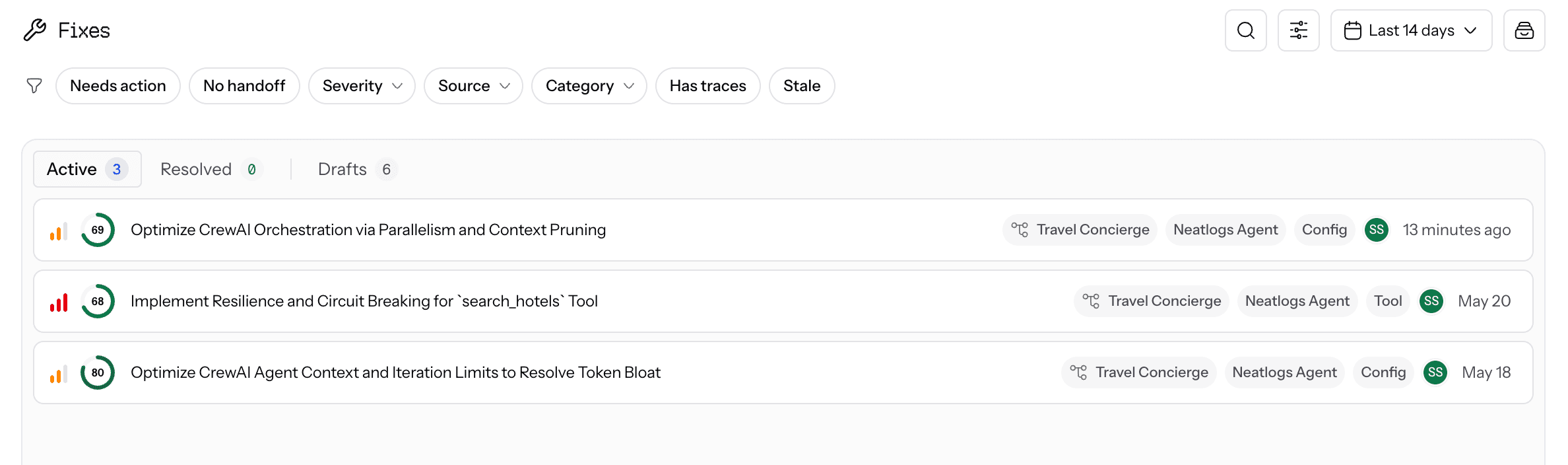
Detections tell you what went wrong. Fixes proposes how — Neatlogs analyzes failing and flagged traces, produces a concrete fix suggestion with root-cause reasoning, and lets you push it to a coding agent that opens a pull request, without leaving the dashboard.
Suggestions
A suggestion is an AI-generated proposal to fix an issue found in a trace. Each one includes:
- Title and description — what the problem is, in plain language
- Analysis — the root-cause reasoning behind the issue
- Location — where in your code the issue likely originates
- Code improvements and best practices — concrete changes to make
- References — links to relevant docs or context
Suggestions live on the Fixes board, split into Active, Resolved, and Drafts tabs. Search and filter them — by severity, source, category, traces, or staleness — and open any one to see its full detail and the investigation that produced it.
The investigation trail
Behind every suggestion is an investigation: the step-by-step reasoning trail the orchestrator followed while building the fix — each tool call and LLM hop it made to localize the bug and decide on a change. The investigation panel shows this trail and the linked traces, so you can see why a fix was proposed, not just what it is. (Your coding agent can re-hydrate this same context through the MCP server when resuming a fix in a fresh session.)
Dispatching a fix to a coding agent
When a suggestion looks right, push it to a coding agent. Neatlogs dispatches the fix — with the suggestion's prompt, your linked GitHub repo, branch, and chosen model — to the agent, then polls until it finishes. When the agent opens a pull request, the PR link is hydrated back onto the suggestion, and you can mark it deployed once shipped.
Cursor Cloud Agents are supported today, with Claude Code and Codex workers planned. Dispatching requires a connected GitHub repository — see Integrations.
How Fixes relates to the rest of Neatlogs
- It builds on Detections and trace failures — those are the signals that surface issues worth fixing.
- The MCP server exposes your fixes and their investigations to your coding agent, so you can review and apply a fix from your editor (
triage_list,triage_get,triage_get_investigation,triage_accept,triage_update_status). - Suggestions support comments, so your team can discuss a proposed fix before dispatching it.